Open data nobody opens
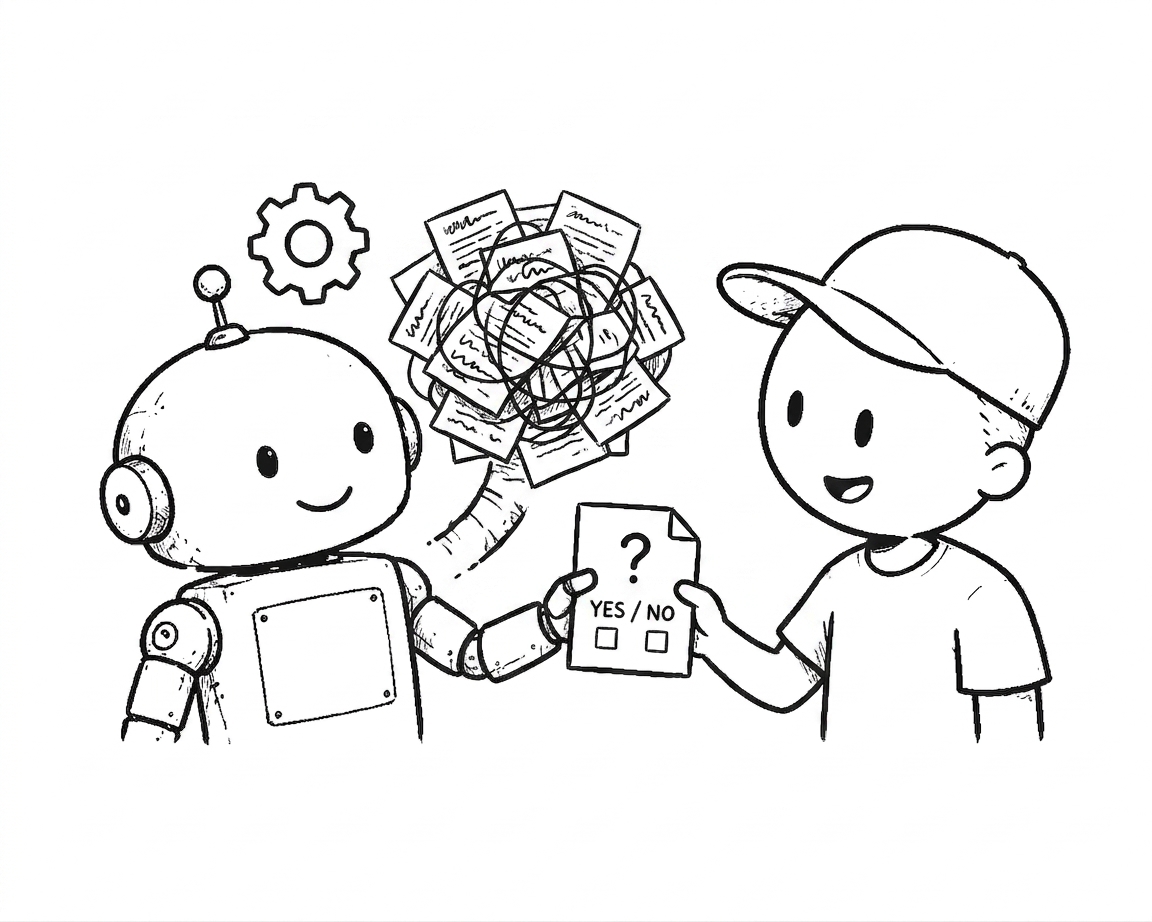
Every vote in the European Parliament and the Slovak National Council is public. The EU even ships it as a clean API. And almost nobody reads it, because the raw record is unreadable: “Návrh poslanca… ktorým sa dopĺňa zákon č. 581/2004 Z. z. … (tlač 1259) — tretie čítanie, hlasovanie o návrhu zákona ako o celku.” Multiply that by a few hundred votes a sitting. Transparency that no human can parse is transparency on paper only.
So I built VoteWatch — a small site on my homelab that turns the record into something a citizen can actually use: what was decided, who voted, and do you agree?
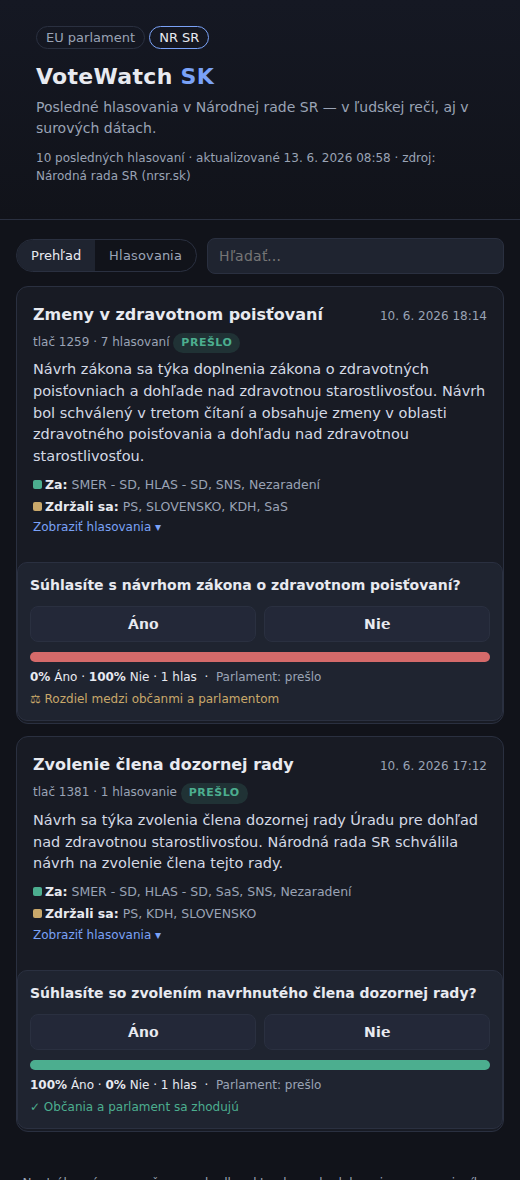
VoteWatch SK: each decision summarised in plain language, which parties voted how, and a Yes/No question whose live citizen tally sits next to how parliament actually voted — labelled agree or gap.
Two halves, one lopsided
The EU half was easy. HowTheyVote.eu already did the hard work and publishes roll-call votes as a clean, open-licensed API. You consume it; you don’t scrape it.
The Slovak half is where the real work lives — and the real value. nrsr.sk
has no API. The HTML is the contract: a results listing, and per-vote
pages where each MP appears next to a one-letter code ([Z] za, [P] proti,
[?] zdržal sa). So the national half is a genuine scraper — the unglamorous
kind that nobody maintains, which is exactly why a gap exists to fill. The
unglamorous part is the moat.
From ten votes to one question
A single bill generates a pile of procedural roll-calls — shorten the debate, move to third reading, amendment block A, amendment block B, the bill as a whole. Ten rows that are really one decision. Nobody wants ten rows.
So the pipeline groups votes by bill, then asks an LLM (llama-3.3-70b on NVIDIA NIM) to do exactly one job: turn the bureaucratic titles into a plain headline, two sentences of summary, and one neutral Yes/No question a person can actually answer. Seven votes on the health-insurer bill collapse into: “Changes to the health-insurance law” → “Do you agree with the health-insurance bill?”
The rule that keeps it honest
Here’s the line I won’t cross, and it’s the whole reason I trust the result: the AI writes the prose, but it never decides a fact.
- Which votes belong to one bill? Deterministic — parsed from the bill number.
- Did it pass? Deterministic — read from the result row.
- Which parties voted for, against, abstained? Deterministic — tallied from the per-MP record, shown as Za: SMER-SD, HLAS-SD, SNS · Zdržali sa: PS, KDH, SaS.
The model only touches language: the headline, the summary, the question. If it hallucinates, you get an awkward sentence — never a wrong vote count. And if the model fails entirely, the card falls back to the raw title. The facts come from the record; the model just makes the record legible. For civic data, that separation isn’t a nice-to-have — it’s the difference between a tool and a liability. (Every card says so out loud: summaries are AI-generated; the raw record prevails.)
The part that closes the loop
Showing people how their representatives voted is only half a feedback loop. The other half is letting them answer.
Each decision carries its one distilled question and two buttons — Áno / Nie. You vote, and the site shows the citizen tally next to how parliament actually decided, with the honest verdict on top: "✓ Citizens and Parliament agree" or "⚖ Gap between citizens and Parliament." That gap is the entire point. It’s the thesis behind a side project of mine called veracracy — governance measured against verified knowledge and the actual will of the governed — made concrete enough to click.
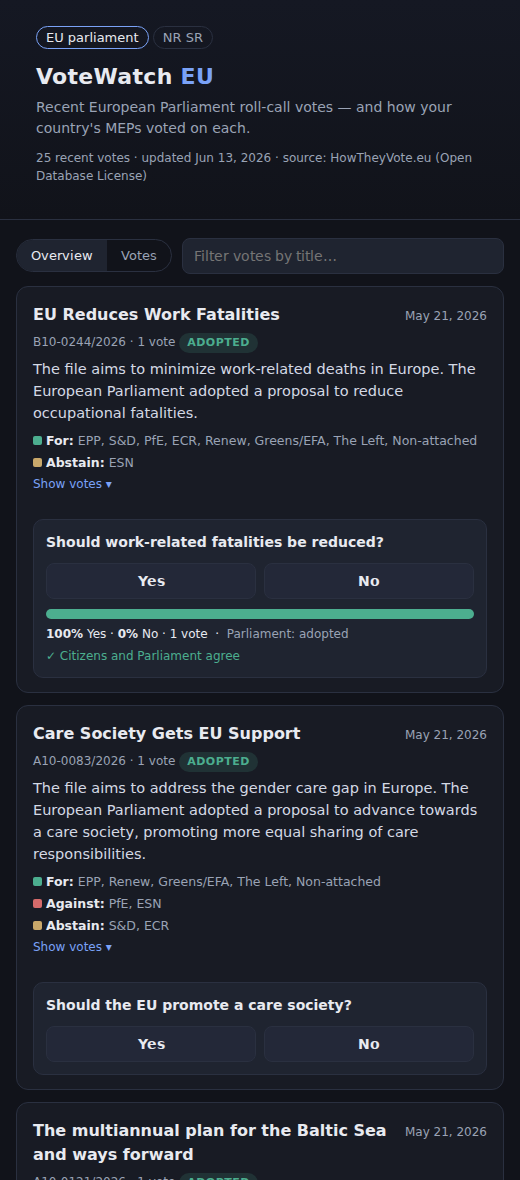
The same loop on the European Parliament — dossiers consolidated, political-group stances (EPP, S&D, PfE…), and the citizen poll under each topic.
The backend is deliberately boring. The site is static (git-synced nginx, same as this blog). Votes can’t POST to a static page, so they go to a public n8n webhook that records to a data table and returns live tallies — no new service, no database, just the automation box I already run. Vote keys are namespaced so EU and Slovak polls share one store without colliding.
The honest caveat
Dedup is browser-local. It stops casual double-voting, but behind a Cloudflare tunnel every request shares one IP, so this is an indicative signal, not a secured ballot. That’s the right altitude for “let people express an opinion.” The day it needs to mean more than that, it needs real identity first — and I’d rather ship the honest version than fake the robust one.
It’s live at votewatch.hippotion.com — the EU parliament and the Slovak NR SR, every MEP and every poslanec, in plain language, with a button that asks the only question that matters after a vote: would you have voted the same way?
A neutral record — what was decided and who decided it — not a villain list.
Data © HowTheyVote.eu (ODbL) and nrsr.sk.