The missing question
Democracies ask what do we want? Markets ask what will we pay? Both are good questions, and between them they run most of the world. But there’s a third question that almost no system asks before it acts, and it’s the one that decides whether the first two produce anything good:
What do we actually know — and how do we know it?
I gave the idea of governing as if that question came first a name — veracracy, from veritas (truth) and kratos (rule). Not rule by experts in a back room. Rule by evidence that anyone can inspect, deliberated by the people it binds. It lives at veracracy.hippotion.com, and this is the honest account of what it is and why an infrastructure engineer ended up building a shrine to an idea.
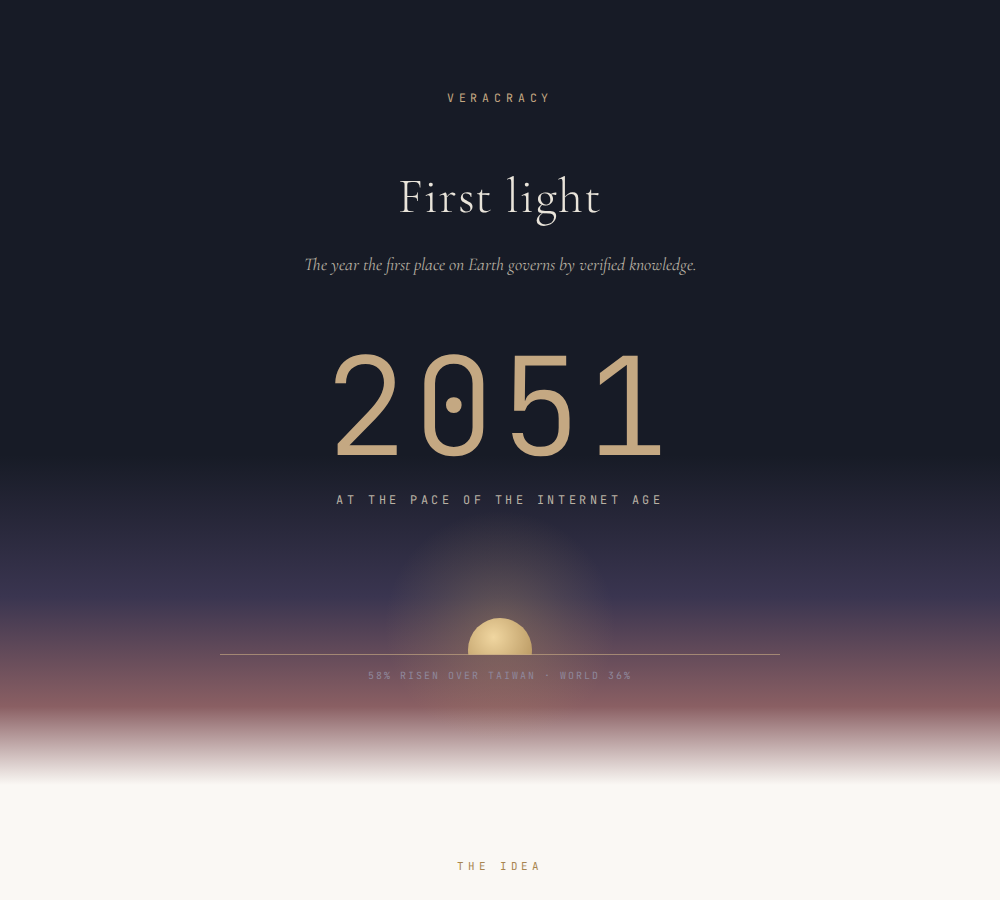
The clock reads ~2051 — computed, not wished, from one published assumption. The sun’s height above the horizon is how far the weighted dials have risen; the tag tracks the beacon (Taiwan) against the world.
What it actually means
Strip the romance and veracracy is five fairly concrete commitments:
- Truth as civic infrastructure. Verified, open evidence maintained like roads and water — with provenance, versioning, and repair crews. A public utility, not a content feed.
- Radical transparency. Binding decisions carry their evidence trail by default. A law without its sources is a claim, not a law.
- Decentralised trust. No ministry of truth. Verification is plural, adversarial, and bridging — many checkers, no single owner, consensus that has to span camps to count.
- Ethical AI as auditor and advocate. Machines that trace claims, surface contradictions, and argue against the powerful reading of the data — never as oracle, always as instrument.
- Participatory epistemocracy. Citizens not as voters once every four years, but as standing jurors of what is true enough to act on, where weight accrues to evidence rather than volume.
If you squint, none of that is a political program. It’s the same instinct I bring to a cluster — provenance, versioning, a reconciler, no single point of trust — pointed at the question of how a society decides what’s real. That’s the only way I know how to think, so that’s the lens I used.
Why a clock, and why it can run backward
Here’s where most “vision” projects lose me, and where I tried not to lose myself. A manifesto is cheap. Anyone can declare a better world and feel moral. So instead of a manifesto, the site is a measurement.
It shows a single year — first light, the year the first place on Earth might plausibly govern this way. Right now it reads around 2051. But that number isn’t a wish; it’s computed, from one assumption stated in plain sight: the infrastructure of verified governance has been built since the world went online in 1991, and continues at the average pace it has held since. A set of dials — open data, civic tech, verification at platform scale — each scored 0–1 from a named source, weighted, extrapolated. Change the assumption and the number moves: pace the same dials from Athens in 508 BC instead, and dawn lands near the year 3860. So the assumption is the lever, which is exactly why it’s published.
And the clock can run backward. There’s a Watch — a standing log of what moved the year — that deliberately files the evidence against: every transparency rollback, every deliberation experiment that failed, every force pushing dawn further out. Because a sunrise that only ever gets closer is a marketing widget. The honesty is the product. If I can’t show you the thing that would move the number the wrong way, you shouldn’t believe the number.
The first brick
Ideas this size are easy to admire and easy to never touch. So the rule I set myself is that veracracy has to cash out in things that actually run.
The first one shipped this week: VoteWatch — every roll-call vote in the European Parliament and the Slovak National Council, scraped from the public record, distilled into plain language, showing which party voted which way, with a button that asks you whether you’d have voted the same. It’s the third and fifth pillars made clickable: binding decisions carrying their evidence trail, and citizens as standing jurors rather than spectators. The gap it surfaces — between how parliament voted and how the people who answered would have — is veracracy in miniature, on real data, today.
It’s small. It’s one person’s homelab. The voting is an indicative signal, not a secured ballot, and I say so on the page. But it’s the difference between a belief and a brick, and I would rather lay one honest brick than write a beautiful manifesto.
Where this comes from
I’ll be straight about the shape of this: it’s idealistic, it’s personal, and I don’t expect to see first light. I’m a solo operator in a small town who runs a rack of servers and thinks too much about how systems stay trustworthy when no one’s watching them. Veracracy is what happened when that instinct refused to stay inside the server room.
The version of this I can defend isn’t the dream — it’s the discipline around the dream. Publish your assumption. Let the clock run backward. Cash the idea out in something real. Credit your sources. Ship the honest version, not the robust-sounding one.
A measurement with one stated assumption — not a prophecy. The clock’s at veracracy.hippotion.com; disagree with a dial and you’ve understood the point.