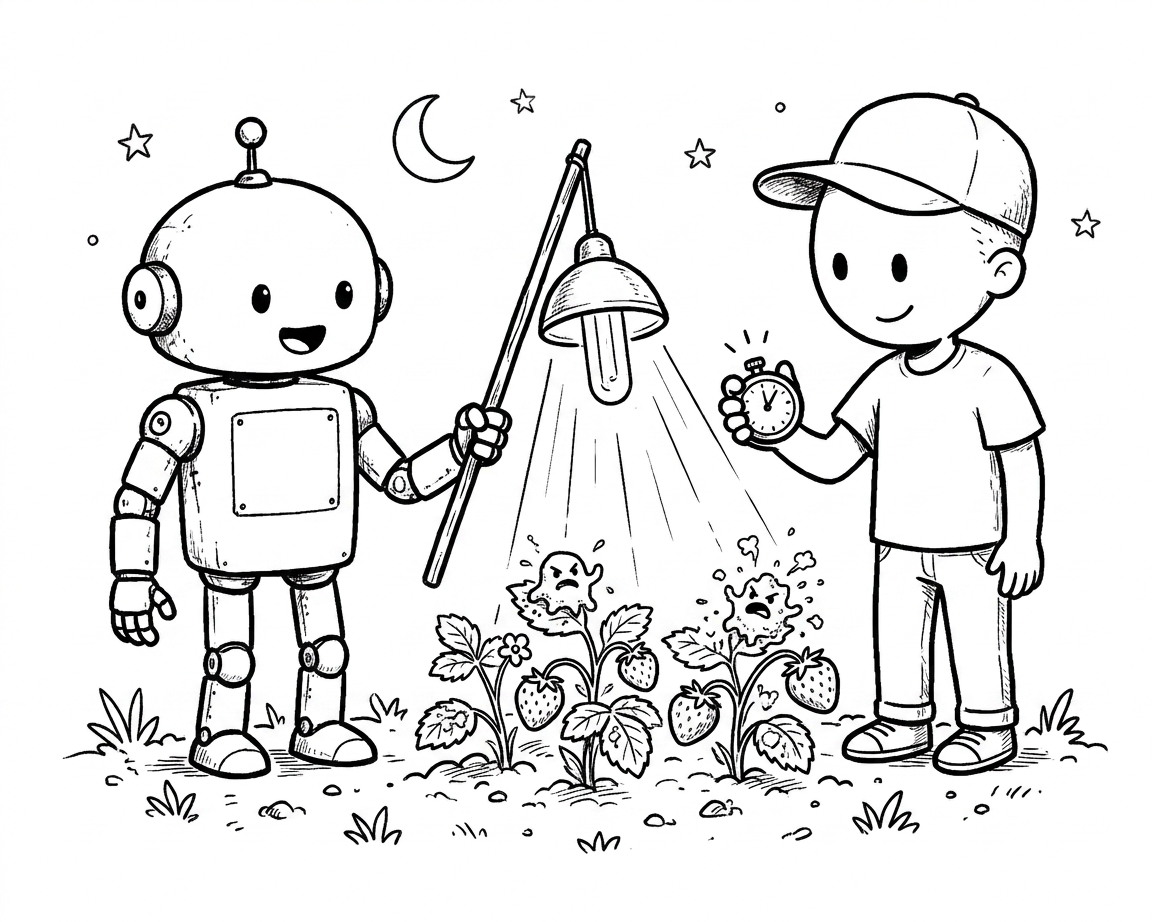
I saw a clip of an autonomous farm robot — TRIC Robotics — driving strawberry beds in total darkness, killing pathogens with UV light instead of spraying them. Zero chemicals, zero runoff. My first reaction was “that’s a marketing robot.” My second, after reading, was “no, the science is real — and the robot is the least interesting part.”
The interesting part is why it works at night.
The trick is the darkness, not the light
UV-C light (254 nm) shreds the DNA of fungal pathogens like powdery mildew. Nothing new there — it’s the same wavelength that sterilises water and hospital rooms. The problem is that in daylight those pathogens repair the damage, using a light-activated enzyme (photoreactivation). Zap them at noon and they patch themselves up by evening.
So you do it in the dark. With the repair pathway switched off, a tiny dose sticks. Cornell’s Gadoury lab spent years on this: nighttime UV-C at doses around 85 J/m² once a week gave season-long powdery mildew control on strawberries that beat the best available fungicides. Grapes, cucumbers, roses — same story. Applied about 30 minutes after sunset, finished within a couple of hours.
That’s a genuinely beautiful result. Not a new chemical, not a stronger lamp — just the same old light, applied when the enemy can’t fix itself.
What it is, and what it absolutely isn’t
Before anyone rips out their whole garden routine: this is not a general pesticide replacement. The evidence is strong for one specific class of problem — surface fungal pathogens, mostly powdery and downy mildew on susceptible plants (strawberry, grape, cucurbits, roses). It does nothing for slugs, most insects, or anything in the soil.
So the honest pitch is narrow: if you fight recurring mildew every summer, this is a chemical-free tool that genuinely works. If your real enemy is aphids, don’t build this — you’d be solving the wrong problem with a dangerous toy.
Which brings me to the toy being dangerous.
The part where I tell you not to blind yourself
UV-C is not mood lighting. Seconds of direct exposure burn your eyes (welder’s-flash) and skin, and it’s a long-term cancer risk. This is the single reason a home version has to be designed carefully — and the reason I’d never run an exposed source in a garden where my kids play.
Any home rig needs, non-negotiably:
- A physical enclosure or skirt so the light only hits the bed, never a person.
- A hard interlock — a motion sensor or door contact that cuts power instantly if anything moves into range.
- A schedule that only ever runs in the dead of night, when everyone’s inside and asleep.
You can also over-dose the plants — too much UV-C scorches leaves. The whole point is that the effective dose is tiny, so more is not better.
The build (the home version of “while you sleep”)
You don’t need TRIC’s autonomous navigation. A home garden has fixed beds — so the robot problem collapses into a much simpler one: get a shielded lamp over a known bed, for a known number of seconds, at night. That’s not robotics. That’s a timer and a rail.
Here’s the plan I’d build:
- The lamp. A low-pressure UV-C tube (254 nm — not the “UV-C LED” novelties, and not ozone-generating 185 nm lamps). Mounted in a hooded reflector so the light points down and is blocked from the sides.
- The geometry. Fix it at a set height over the bed — on a simple cart that rolls a track, or just a static fixture over a raised bed. Fixed height = repeatable dose.
- The dose, measured not guessed. This is the one place you can’t wing it: borrow or buy a
UV-C meter, measure the irradiance (W/m²) at canopy height, then
time = 85 ÷ irradiance. If the lamp delivers, say, 5 W/m² at the leaves, that’s ~17 seconds of exposure. Seventeen seconds, once a week. That tiny number is the whole reason this is plant-safe and low-energy — and why a slow-moving robot pass is enough on a farm. - The brain. This is the bit that’s actually in my wheelhouse: an ESP32 + a relay, on the
homelab. Fires at 2 a.m. for N seconds, once a week. A PIR sensor wired as a kill-switch. A
mind-the-gap-style cron and a log line to my phone when it ran. The “autonomous robot working while you sleep” headline, minus the $100k of autonomy I don’t need for four raised beds.
Verdict
I haven’t built this yet — it’s a someday project, parked here so I stop losing the idea. But it’s the rare someday project where the science is settled, the materials are cheap, and the only real engineering is safety and dose control, both of which are squarely the kind of problem I like.
The farm robot’s pitch is “pesticide-free at scale.” The home version’s pitch is smaller and more honest: if mildew is your summer tax, you can pay it in seventeen seconds of midnight light instead of a spray bottle. I’ll take that trade.
When I build it, the failure log gets its own post.