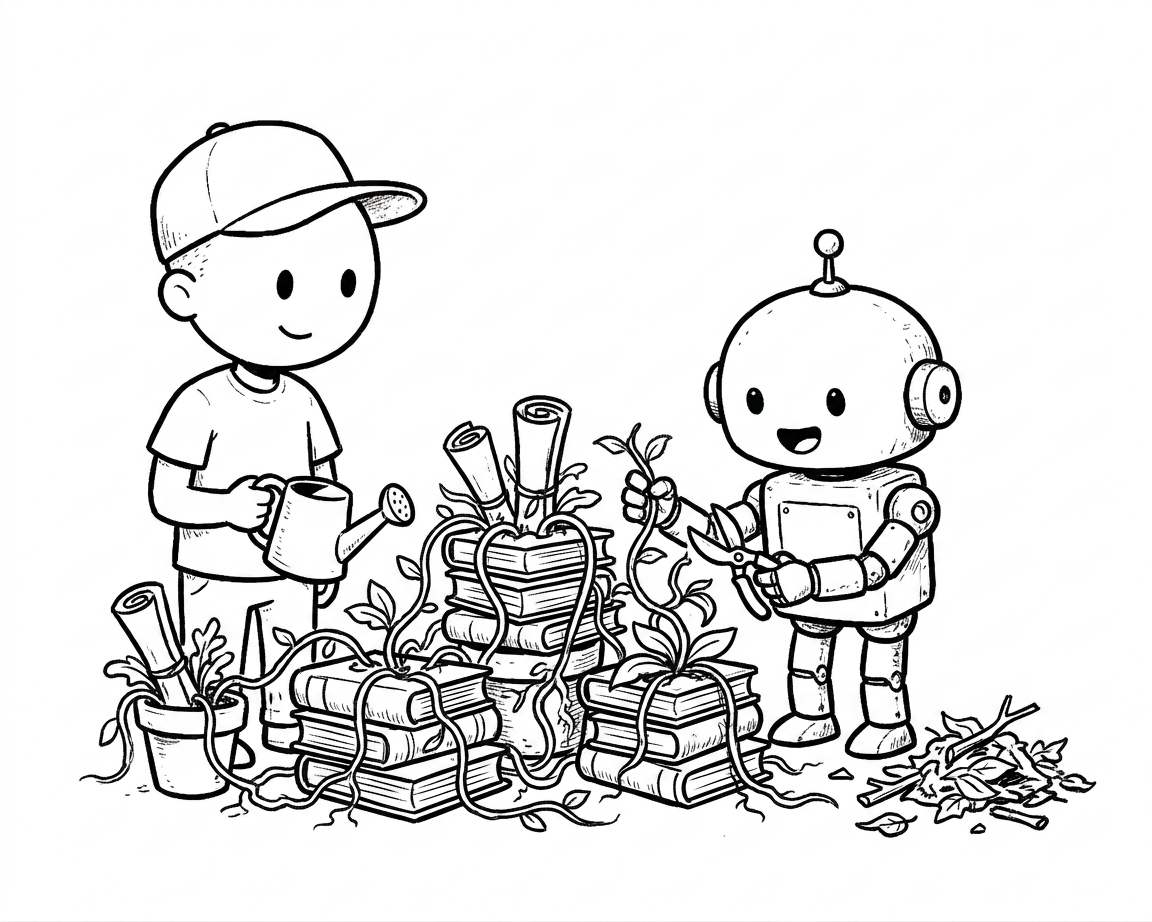
A few weeks ago I rebuilt my second brain as a folder of markdown in git — vault is the source of truth, everything else (search index, graph, 3D viewer) is a derived layer I can delete and rebuild. I love it. But a knowledge base has a dirty secret: it rots.
Not the files — those are fine. The connections rot. You capture a note at 11pm and never link it to anything, so it becomes an orphan floating off the graph. A project note’s one-line summary describes what the project was three weeks ago. Two notes are obviously about the same thing and neither knows the other exists. Do this for a few months and you don’t have a second brain, you have a junk drawer with good search.
The honest fix is to weed the garden regularly. The honest truth is that nobody does, including me.
So I stopped relying on myself and built a gardener.
What it actually does
Every night at 3am, on my homelab box, a script runs:
- Detect —
exo garden, a plain query over the index, produces a report: here are the orphans, here are notes that should probably link to each other, here are summaries that look stale. No AI in this step. It’s SQL and graph traversal. Deterministic, boring, trustworthy. - Decide and write — that report gets piped to
claude -p(Claude Code in headless mode). Claude reads the vault’s operating contract, makes only high-confidence edits — add a[[wikilink]]between two genuinely related notes, refresh a stale summary — caps itself at ~10 notes a night, and writes a dated log note explaining exactly what it changed and what it deliberately skipped. - Commit — the wrapper reindexes and lands everything as a single
garden: 2026-06-09 …git commit, then pushes. My 3D graph viewer picks it up on the next sync.
The first real run, it found one orphan (90-meta/README), linked it into the notes it actually indexes, and then — this is the part I liked — declined to touch the 12 “stale summary” candidates because, on inspection, every one of them was already accurate. It wrote: “flagged by length, not staleness; churning them would add noise.” A gardener that knows when not to prune is the one you can leave alone.
“Isn’t this a solved problem?”
Mostly, no — but partly, yes, and I want to be straight about it. AI-assisted note-linking exists: Obsidian plugins like Smart Connections suggest related notes, and apps like Mem and Reflect auto-organize as you write. They’re good.
Three things make this different enough to build:
- Every change is a reviewable git diff, authored by a named agent. Not silent magic that rearranges your notes while you’re not looking.
git log -pshows you exactly what the gardener did last night;git revertundoes a bad night in one command. For something as personal as a knowledge base, “show me the diff” beats “trust me.” - It’s mine, end to end. Runs on my hardware, on my schedule, with a model I point at. No SaaS holds my brain hostage.
- The detection is deterministic; the model only acts. The LLM never decides what’s wrong — a boring query does that. The model only decides how to fix the things already found. That split keeps the whole thing auditable and cheap.
If you already live in a tool that does this and you trust it, great. I wanted the git-diff trail and the local control.
The part I actually want to tell you about
The plan was tidy: I run n8n on the same cluster, so n8n would be the scheduler — fire nightly, SSH into the node, run the gardener. Clean, visual, one workflow.
n8n could not reach the node. At all. Every port: ECONNREFUSED.
This sent me down a genuinely interesting hole, because the homelab runs Cilium for networking, and Cilium has opinions about your own node that plain Kubernetes does not.
First instinct: a NetworkPolicy allowing egress to the node’s IP. Wrote it, synced it, still refused. The reason is a Cilium subtlety worth knowing: the node isn’t a CIDR, it’s an identity. Cilium classifies your cluster’s own node as the special host identity, and ordinary ipBlock CIDR rules do not match it unless you flip a cluster-wide setting (policy-cidr-match-mode: nodes). My 192.168.0.109/32 rule was a no-op.
So I switched to the Cilium-native tool: a CiliumNetworkPolicy with toEntities: [host]. Confirmed it applied — I could see reserved:host allowed right there in the datapath’s BPF policy map. I confirmed the node’s IP really does resolve to identity 1 (host). I confirmed the host firewall was disabled. Everything said “allowed.”
Still ECONNREFUSED.
That’s the wall. The packet leaves the pod with Cilium’s blessing, hits the host’s own network stack, and something there sends a reset — and I couldn’t see what, because inspecting the host firewall needs root, and this automation deliberately doesn’t have it. I could have kept digging with a password. But I stopped and asked a better question: why am I making a pod reach back into the host it’s running on at all?
That’s an awkward direction. The work has to happen on the host (that’s where the vault, git creds, and Claude live). A pod straining to SSH into its own node is fighting the grain of the platform.
So I inverted it. The node schedules itself — a plain cron entry, rock-solid, no network gymnastics. And n8n, instead of triggering the job, receives it: at the end of each run the node POSTs a summary to an n8n webhook. Node→n8n works perfectly (it’s just an outbound HTTPS call to a URL). n8n keeps the run history and is the place I’ll later wire a phone notification.
I lost nothing that mattered. n8n is still my dashboard; the schedule just lives where the work lives. And I deleted the SSH key and the network-policy hole I’d opened — the cleanup felt better than the original plan would have.
The lesson, such as it is
Two, actually.
One: when you’re automating something to run unattended, the bug you want to find is the one that shows up in a dry run at 2pm, not at 3am three weeks from now. I almost shipped a version where a brand-new note (untracked by git) was invisible to my change-detection and would’ve been silently wiped each night. The dry run caught it. Always build the dry run.
Two, the bigger one: I spent an hour trying to make a pod punch into its host because that was my plan, and the platform kept saying no in increasingly specific ways. The fix wasn’t a cleverer NetworkPolicy. It was noticing I was pushing against the design and turning around. The node scheduling itself and reporting up to n8n is simpler, safer, and more honest about where the work actually lives.
My brain weeds itself now. Every morning there’s maybe one small, sensible commit waiting — a link I’d have never made, a summary nudged back to true — and I can read exactly what changed before my coffee’s done. That’s the whole dream of a second brain that isn’t a junk drawer: it stays a garden, and I barely have to touch it.